The Infrastructure Behind How We Ship Silicon
Vyges uses metadata, automation, and verification internally to deliver fab-ready SoC IP faster.
This page explains the architecture — not a product you buy.
Vyges uses metadata, automation, and verification internally to deliver fab-ready SoC IP faster.
This page explains the architecture — not a product you buy.
Why we deliver silicon in weeks, not months
Design chips — not orchestrate tools. A model reasons about the design; Vyges executes it against real sign-off engines and your own IP — so a tapeout that took months takes weeks.
  AI reasons  ─►  your AI IDE / vyges mcp  ─►  Loom executes  ─►  VyCatalog remembers  ─►  Silicon
                    (connects AI to tools)      (sign-off + fixes)   (reusable IP + metadata)   (weeks, not months)
A model can talk about closing timing — it cannot run your extraction, timing, or verification, and it does not know your IP or your PDK. Vyges is the layer that lets any model actually do the work — the same tools, the same metadata, the same silicon flow, whichever model you pick.
AI models are replaceable. Your silicon flow isn't.
Validated with SemiKong. A locally hosted SemiKong model has driven vyges mcp tool calls end-to-end — running a real deterministic sign-off engine to a correct verdict, entirely on local hardware.
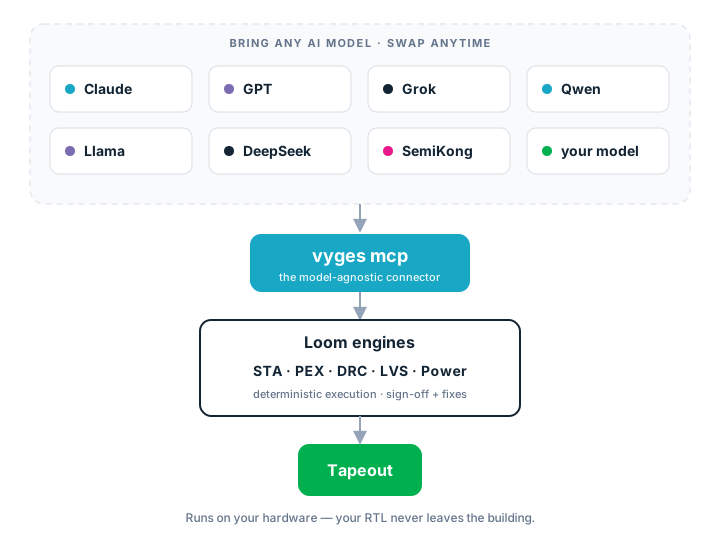
Every engineer already knows how to use Claude or Cursor. Now those same assistants can drive real silicon implementation tools. See how it works →
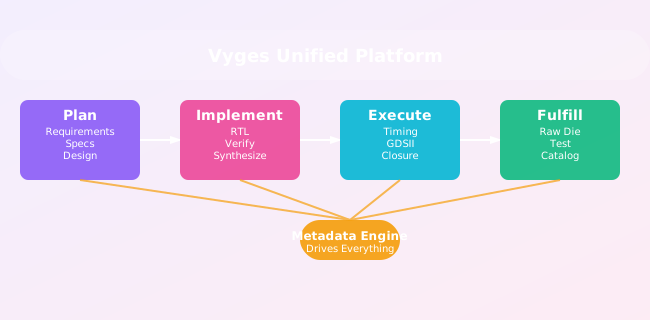
Silicon design is traditionally phase-gated and manual. Vyges redefines each phase with automation, open tooling, and metadata orchestration — reducing friction from spec to silicon.
Define intent, capture specs, and extract constraints with clarity and structure
Develop, verify, and synthesize RTL with integrated AI and automation
Achieve timing closure and generate GDSII-ready layouts with minimal iteration
Validate silicon, manage packaging, and distribute through trusted catalogs
Most silicon teams are integrators, not IP authors. Vyges accelerates the front end through two paths — pick from pre-built IPs already in the open registry, or author new IPs and glue modules with the Vyges Metadata Standard enforced inside the IDE. Most programs use both.
For application developers and integrators
For core systems developers writing RTL or glue modules from scratch
Vyges supports backend success today through open and commercial PDKs, and operates the silicon fulfilment infrastructure that delivers verified IP to fab.
A modular system of tools and flows designed to streamline every stage of silicon IP development — from first spec to verified release.
One command-line interface to manage the entire IP lifecycle — from spec to release and compliance.
Learn More →An AI IDE extension that enforces Vyges Metadata Standard conventions inside VS Code and Cursor — onboard faster and ship consistent IP.
Learn More →A portable testbench and PDK flow environment — from RTL to GDSII in a container.
Learn More →Tools for chip bring-up, raw die testing, and dev board workflows — crucial for silicon validation.
Learn More →Explore, publish, and reuse IP with full metadata, docs, and version control — in one place.
Learn More →Secure your IP with encryption, signing, and compliance — ready for trusted distribution.
Learn More →Open EDA sign-off suite — characterization, extraction, power, timing+SI, IR/EM, thermal, and LVS, over the geometry kernel.
Learn More →One metadata layer. Every stage, every tool. The Vyges Metadata Specification is the backbone of lifecycle automation.
Engines can be reimplemented; a standard becomes infrastructure. The Vyges Metadata Standard is the layer AI can actually understand — and the one with network effects.
Requirements, design intent, and constraints — captured in a structured format
RTL config, test targets, and synthesis settings — standardized for automation
Timing, layout guidance, and toolchain compatibility — all metadata-defined
IP licensing, packaging, and deployment rules — embedded and validated
Silicon IP development today is slow, fragmented, and error-prone. Disconnected tools, handwritten metadata, and inconsistent standards create friction across teams — delaying time to market and inflating cost.
Tools and teams operate in silos. There's no standard way to create, package, or integrate IP across vendors or flows.
Handwritten metadata. Manual verification. Glue scripts everywhere. Scaling across teams becomes painful.
Without a clear compliance baseline, IP quality is unpredictable — leading to late-stage failures and costly debug cycles.
One platform. Every phase. Vyges automates IP creation, validation, and integration — making silicon development faster, scalable, and verifiable by design.
Vyges unifies the entire silicon IP lifecycle — from requirements to GDSII — into a single schema-driven workflow. No more handoffs, no more glue scripts.
With intelligent automation at every step, teams can move faster, collaborate better, and trust the quality of what they build.
JSON-based schema for describing, validating, and orchestrating IP components
Developer-friendly tools for validation, automation, and continuous integration
Generative models for RTL, testbenches, constraints, and docs — boosting productivity
Tools for secure IP distribution, signing, and metadata-based cataloging
Vyges is built on a three-layer architecture that spans the entire silicon IP lifecycle—combining intelligent creation, standardized validation, and seamless deployment. Designed for scale. Engineered for trust.
AI-powered templates and assisted development accelerate RTL, constraints, and documentation — right from the start.
Everything is metadata-defined — enabling schema-based validation, compatibility scoring, and catalog search.
CI pipelines, toolchain orchestration, and platform-aware packaging for ASIC, FPGA, and chiplets.
Smart templates and generative tools speed up development while ensuring structure, metadata completeness, and quality from the start.
Structured metadata makes every IP block discoverable, verifiable, and interoperable—reducing risk during integration.
Vyges connects to your toolchain and automates integration—from synthesis to packaging—with traceable, production-ready output.
Vyges compounds value at every phase — accelerating delivery today, and future-proofing your silicon design flow for scale, reuse, and collaboration.
Accelerated planning, templating, and AI-assisted RTL generation
Toolchain flexibility across open and commercial flows
Automated test coverage, traceability, and continuous validation
Modular, schema-based, and built for evolving teams
Start with proven templates and structure from day one
Browse, integrate, and extend trusted, high-quality blocks
No refactoring as designs or teams scale
Accelerate silicon cycles by weeks or even months
Vyges thrives on momentum. Every new IP, user, or integration adds value—boosting automation, discoverability, and intelligence across the ecosystem.
Every IP published enriches the ecosystem—accelerating reuse, improving discovery, and enabling smarter integration across teams.
With each new tool integration, manual steps vanish—empowering engineers to spend more time designing and less time wiring flows together.
As more projects and teams use Vyges, its AI becomes sharper—delivering higher-quality code, tighter tests, and smarter automation.
From lean startups to enterprise design teams, Vyges empowers faster silicon development, better quality, and scalable collaboration—at every stage of the journey.